|
Name:
Bob Boyle
When
Donated: July 2003
Comments
on Donation: The transistors are in
the original boxes.........RCA matchbook packs, etc. I think you are right about the age, (1960s).
I can't remember exactly when I got them, but that's about the time. I worked as a computer development
engineer in the fifties for Sperry Gyro, then at Ramo-Wooldridge (now TRW),
in the sixties, and Gen'l Dynamics, among others, in the seventies. Your response triggers a lot of near
forgotten memories! My work at
Sperry was as a development engineer on the MSG-5, an army signal corps
computer/radar system designed to locate and track low flying enemy aircraft
which might evade detection by the IBM "Sage" surveillance
system. At that time (early 50's)
we were still using vacuum tubes (5963, 6201, 5755) and germanium diodes
(1N34) as circuit components.
Subsequently, after Shockley, the program was reconstituted to use
solid state components at which point I left for RW in LA and worked on the
RW 300, the first process control computer. It was a transistorized machine, using 2N167's as the active
elements with dynamic logic and a clock that ran at the fantastic super
speed of 18 khz! We actually put it
in production and about twenty were sold and installed around the country
in a variety of applications------vinyl monochloride at Monsanto, latex
rubber at Phillips petroleum, a fractionating column at Texaco and others. I really don't remember very much of the
circuitry offhand, as you undoubtedly know, the initial logic was basic
diode gates, flip-flops, shift registers, half adders, etc. The sixties, as I remember, were
characterized by constant change, it was difficult to do circuit design
inasmuch as before you could finish testing prototypes there were new and
much improved elements available.
Such was the price of progress!
|
1960s
PRODUCTION GERMANIUM TRANSISTORS
Early 1960s production
germanium transistors, all in original packaging. Examples include Raytheon 2N404 (date code 1961), RCA 2N175
(date code 1961), and RCA 2N270 (date code 1960). Also, rectifiers from Hoffman and TI, including 1N702.
|
2003_100
|
|
Name:
Jim Loocke
When
Donated: June 2003
Comments
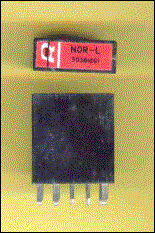
on Donation: I have some black modules I believe were part of a very early
computer built by a company called Radiation, Inc. They built the Pulse Code Modulation
system for the Apollo. The modules
have labels like NOR-M and CSR-L or D?A-1 and so on. I broke a couple of the modules apart
and inside I found discrete component resistors, transistors and diodes. I know that Radiation made the Pulse
Code Modulation system for the Apollo.
The man I got these from said he thought they were ground support
equipment. These are from around 1966 and were built
for the Apollo by AC Electronics, a
division of General Motors. These
modules contain the finest Mil spec components available. There was no room for failure of these
components. They were put through an unbelievable amount of testing, and
the cost was astronomical. They
averaged over $1000 each in 1966 dollars.
|
|
2003_101
|