|
EARLY
TRANSISTOR HISTORY AT BELL LABS An Interview with Walter MacWilliams Developing the First “Working” Transistor Application |
||
|
|
|
|
|
|
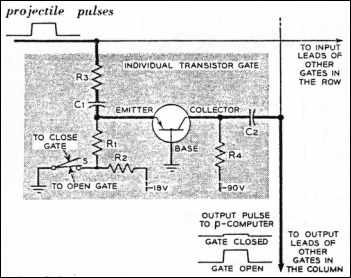
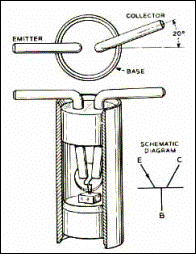
The schematic (above left) is from Walter’s 1957 Bell Labs Record article [2] and illustrates the circuitry associated with each of the 40 transistor switches used in the Transistor Gating Matrix. Here are the technical specs from the article: “A matrix of 40 gates was used in the simulator. The measured outputs of the gates (with an input of 3-v, 5-microsecond pulses occurring at a 5-kc repetition rate) gave a maximum signal for a closed gate of 0.1 volt, and a minimum signal for an open gate of 16 volts, which represents a voltage discrimination of 44db. In use, the matrix was quite successful. It was operated with the simulator for somewhat over a year and a half, and during this period only one transistor had to be replaced.” This high level of reliability is quite remarkable, given the multitude of unknown device characteristics for these early transistors. Above is a diagram of the 1949 vintage Type A point contact transistor used by Walter in his design, which was done within a few months of the June 1948 public announcement of the invention of the transistor by Bell Labs. [4] Go To MacWilliams Oral History, Pg 8 |
|
|
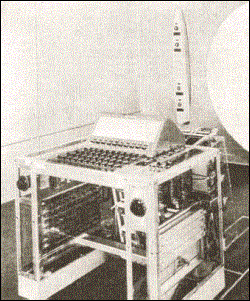
The above is a photo showing the control center of
the ATEWA system, which was constructed at Bell Labs, Whippany, N.J., from 1949
to 1951. As described by Walter MacWilliams [1]
this project was likely one of the largest aggregations of electronic
equipment at that time. It was in the
development of the ATEWA that pre-production transistors were used in
1949.
|
||
|
COPYRIGHT
© 2005 by Jack Ward. All Rights
Reserved. http://www.transistormuseum.com/ PAGE
7 |
||